
Note
Go to the end to download the full example code.
Calculating the SNR associated with an astrophysical signal model#
The example Filtering a TimeSeries to detect gravitational waves showed us we can visually extract a signal from the noise using basic signal-processing techniques.
However, an actual astrophysical search algorithm detects signals by calculating the signal-to-noise ratio (SNR) of data for each in a large bank of signal models, known as templates.
Using PyCBC (the actual search code), we can do that.
Data access and conditioning#
First we fetch some of the public data from GWOSC:
from gwpy.timeseries import TimeSeries
data = TimeSeries.get("H1", 1126259446, 1126259478)
and condition it by applying a highpass filter at 15 Hz
high = data.highpass(15)
This is important to remove noise at lower frequencies that isn’t accurately calibrated, and swamps smaller noises at higher frequencies.
For this example, we want to calculate the SNR over a 4 second segment, so
we calculate a Power Spectral Density with a 4 second FFT length (using all
of the data), then crop() the data:
psd = high.psd(4, 2)
zoom = high.crop(1126259460, 1126259464)
Generating a signal model#
In order to calculate signal-to-noise ratio, we need a signal model
against which to compare our data.
For this we import pycbc.waveform.get_fd_waveform and generate a template as a
pycbc.types.FrequencySeries:
/home/docs/checkouts/readthedocs.org/user_builds/gwpy/conda/latest/lib/python3.13/site-packages/pycbc/waveform/nltides.py:13: SyntaxWarning: invalid escape sequence '\p'
  Delta Psi(f) = 2 \pi f Delta t(f) - Delta phi(f)
/home/docs/checkouts/readthedocs.org/user_builds/gwpy/conda/latest/lib/python3.13/site-packages/pycbc/tmpltbank/calc_moments.py:333: SyntaxWarning: invalid escape sequence '\i'
  \int funct(x) * (psd_x)**(-7./3.) * delta_x / PSD(x)
/home/docs/checkouts/readthedocs.org/user_builds/gwpy/conda/latest/lib/python3.13/site-packages/pycbc/tmpltbank/option_utils.py:177: SyntaxWarning: invalid escape sequence '\i'
  "space metric:  integrals of the form \int F(f) df "
/home/docs/checkouts/readthedocs.org/user_builds/gwpy/conda/latest/lib/python3.13/site-packages/pycbc/tmpltbank/option_utils.py:178: SyntaxWarning: invalid escape sequence '\s'
  "are approximated as \sum F(f) delta_f.  REQUIRED. "
Calculating SNR#
At this point we are ready to calculate the SNR, so we import the
pycbc.filter.matched_filter method, and pass it
our template, the data, and the PSD:
Tip
Here we have used the to_pycbc() methods of the
TimeSeries and FrequencySeries
objects to convert from GWpy objects to something that PyCBC functions
can understand, and then used the from_pycbc() method
to convert back to a GWpy object.
Visualisation#
We can plot the SNR TimeSeries around the region of interest:
plot = snrts.plot()
ax = plot.gca()
ax.set_xlim(1126259461, 1126259463)
ax.set_epoch(1126259462.427)
ax.set_ylabel("Signal-to-noise ratio (SNR)")
ax.set_title("LIGO-Hanford signal-correlation for GW150914")
plot.show()
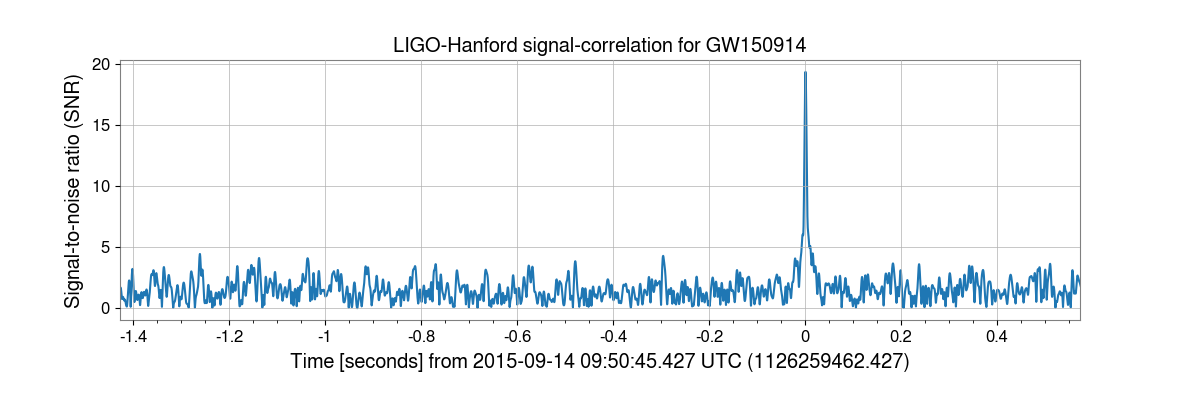
We can clearly see a large spike (above 17!) at the time of the GW150914 signal! This is, in principle, how the full, blind, CBC search is performed, using all of the available data, and a bank of tens of thousand of signal models.
Total running time of the script: (0 minutes 1.205 seconds)