
Note
Go to the end to download the full example code.
Accessing and visualising public GW detector data#
Data from the current generation gravitational wave detectors are published by The Gravitational-Wave Open Science Centre (GWOSC) and freely available to the public. In this example we demonstrate how to identify times of a published GW detection event, and to download and visualise detector data.
Firstly, we can use the gwosc Python package to query for the time of the first gravitational-wave detection GW150914:
GWpy’s TimeSeries class provides an interface to the public GWOSC
data in the get() method; to use it we
need to first import the TimeSeries object:
from gwpy.timeseries import TimeSeries
then call the get() method, passing it the
prefix for the interferometer we want ('L1' here for LIGO-Livingston),
and the GPS start and stop times of our query (based around the GPS time
for GW150914):
and then we can make a plot:
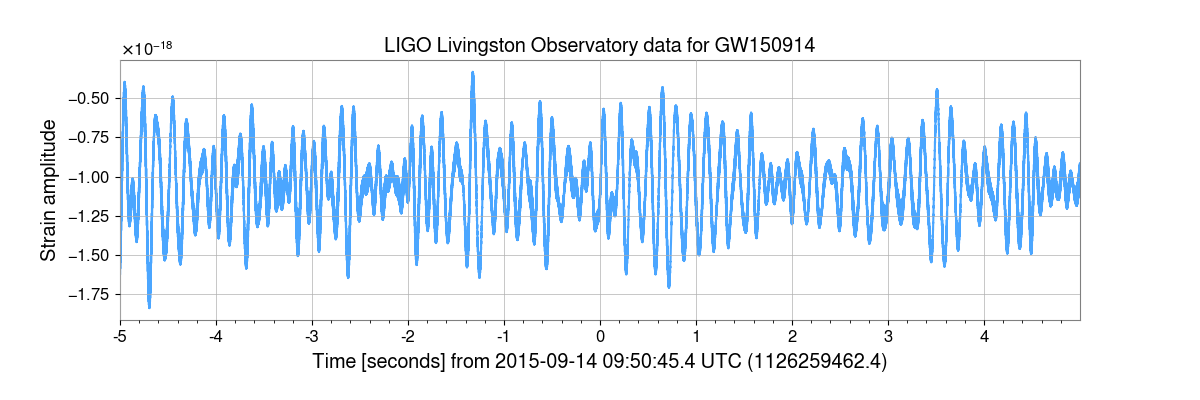
We can’t see anything that looks like a gravitational wave signal in these data, the amplitude is dominated by low-frequency detector noise. Further filtering is required to be able to identify the GW150914 event here, see Filtering a TimeSeries to detect gravitational waves for a more in-depth example of extracting signals from noise.
Total running time of the script: (0 minutes 1.335 seconds)