
Note
Go to the end to download the full example code.
Calculate the coherence between two channels#
The coherence between two channels is a measure of the frequency-domain correlation between their time-series data.
In LIGO, the coherence is a crucial indicator of how noise sources couple into
the main differential arm-length readout.
Here we use use the TimeSeries.coherence() method to highlight coupling
of the mains power supply into the strain output of the LIGO-Hanford
interferometer.
These data are available as part of the O3 Auxiliary Channel Data Release.
Data access#
First, we import the TimeSeries
from gwpy.timeseries import TimeSeries
and then get() the LIGO-Hanford strain data,
and the mains power monitor data, for a 600-second window near the
end of the O3 Auxiliary Channel Data Release:
Data are accessed separately
We could have used TimeSeriesDict.get to access both channels in a
single call - that method would first try to find a single dataset that
contain both of them, then automatically fall back to separate calls if
that fails.
But, since we know that these channels are in different datsets, we access them separately here for clarity and speed.
Calculating coherence#
We can then calculate the coherence() of one
TimeSeries with respect to the other, using an 8-second Fourier
transform length, with a 4-second (50%) overlap:
coh = strain.coherence(mains, fftlength=8, overlap=4)
/home/docs/checkouts/readthedocs.org/user_builds/gwpy/checkouts/stable/gwpy/signal/spectral/_ui.py:356: UserWarning: Sampling frequencies are unequal. Higher frequency series will be downsampled before coherence is calculated
  return method_func(
The output of this method is a FrequencySeries
containing the coherence values for each frequency bin.
Visualisation#
We can now plot() the coherence:
plot = coh.plot(
    xlabel="Frequency [Hz]",
    xscale="log",
    ylabel="Coherence",
    yscale="linear",
    ylim=(0, 1),
)
plot.show()
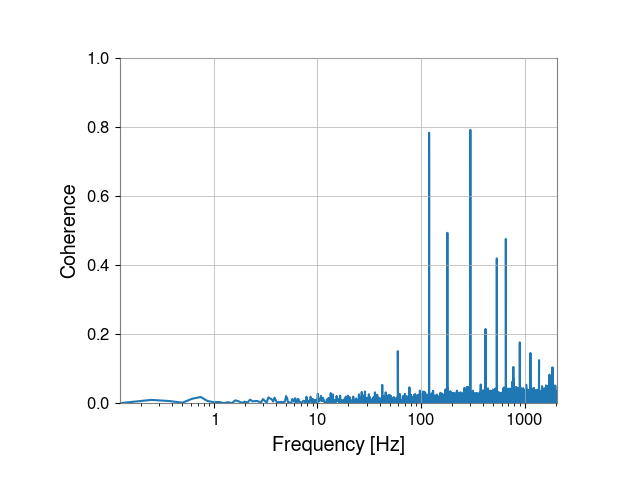
Here we can see strong coherence at 60 Hz and its harmonics, indicating that the mains power supply is coupling into the differential arm length control loop.
Total running time of the script: (0 minutes 23.651 seconds)