
Note
Go to the end to download the full example code.
Inject a signal into a FrequencySeries#
It can often be useful to add some known signal to inherently random or noisy data. For example, one might want to investigate what would happen if a binary black hole merger signal occured at or near the time of a glitch. In LIGO data analysis, this procedure is referred to as an injection.
In the example below we will create a stream of random, white Gaussian noise, then inject a loud, steady sinuosoid. We will do this in the frequency domain because it is much easier to model a sinusoid there.
Generate random data#
First, we prepare one second of Gaussian noise using
numpy.random.Generator.normal:
from numpy.random import default_rng

from gwpy.timeseries import TimeSeries

rng = default_rng()
noise = TimeSeries(rng.normal(scale=.1, size=1024), sample_rate=1024)
To inject a signal in the frequency domain, we need to take an FFT:
noisefd = noise.fft()
Inject noise#
We can now easily inject a loud sinusoid of unit amplitude at, say,
30 Hz. To do this, we use
inject():
import numpy

from gwpy.frequencyseries import FrequencySeries

signal = FrequencySeries(numpy.array([1.]), f0=30, df=noisefd.df)
injfd = noisefd.inject(signal)
Visualisation#
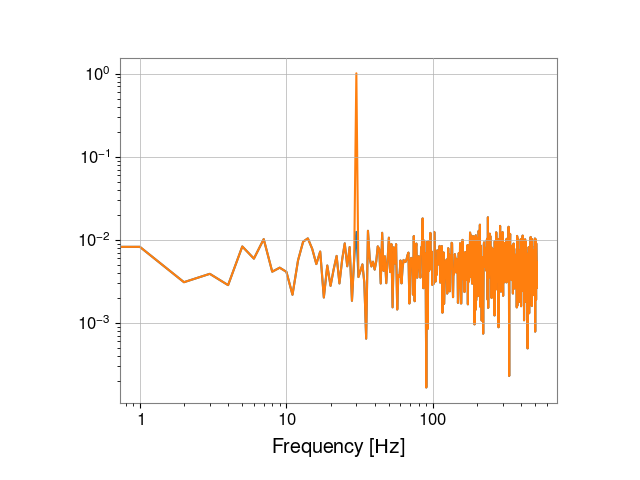
We can then visualize the data before and after injection in the frequency domain:
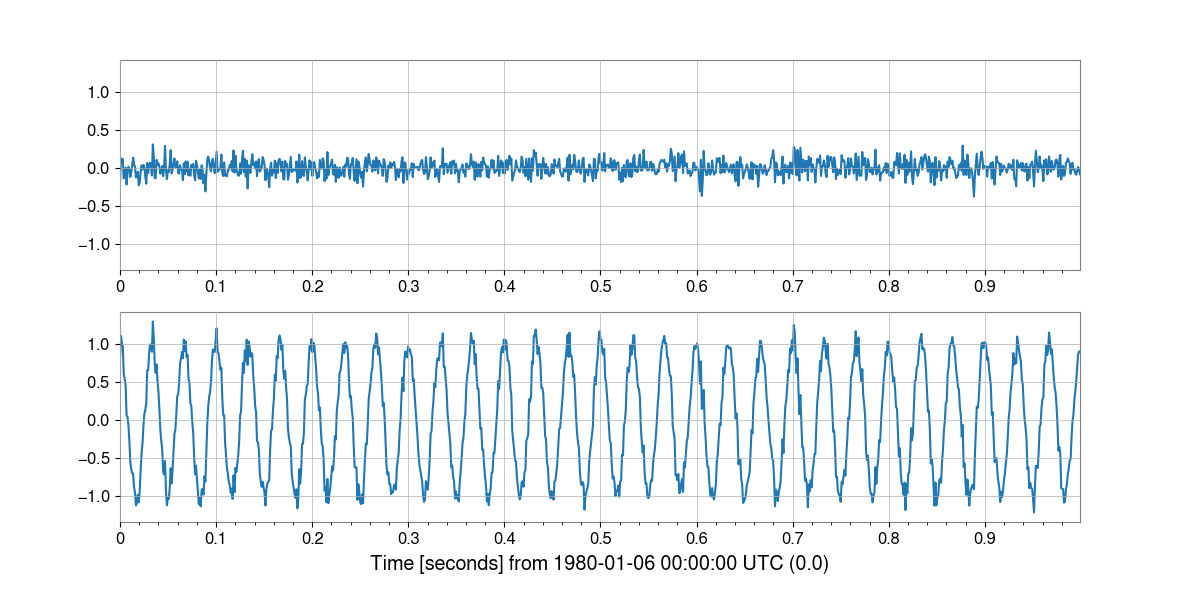
Finally, for completeness we can visualize the effect before and after injection back in the time domain:
Total running time of the script: (0 minutes 0.589 seconds)